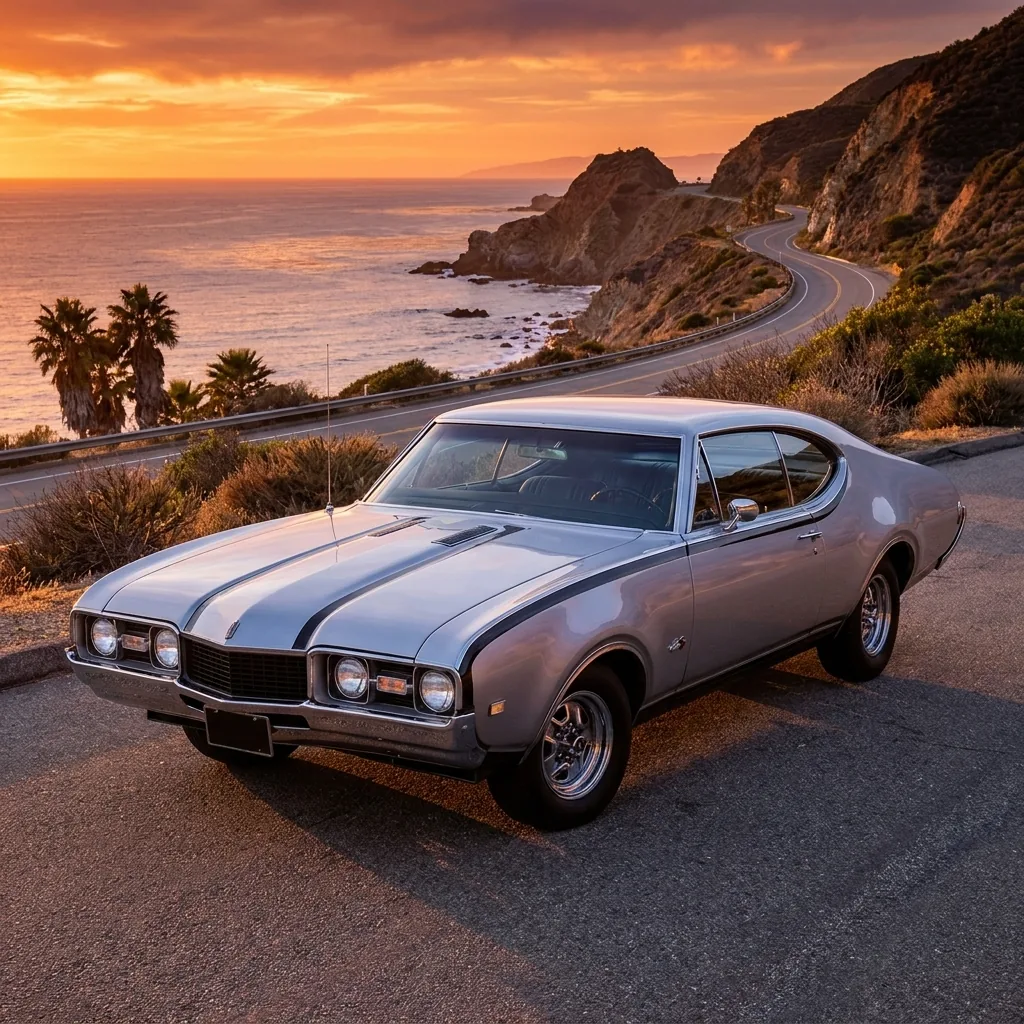
The 1968 Hurst/Olds is often described as a clever way to put a 455 cubic inch engine where a corporate policy seemed to discourage it. That broad story explains the attraction, but it can also hide an important production detail. The engine installation and the Hurst-associated finishing work were not the same operation. Understanding who did what makes the car more interesting than a vague tale about a secret engine swap.
The Hurst/Olds Club of America’s research identifies 515 production cars for 1968, with silver-and-black presentation and a 455 V8. Its detailed spotting guide explicitly states that the engines were installed at the Oldsmobile assembly plant. It separately describes work performed at the Demmer facility, including paint details, identification, interior trim, and the Dual-Gate shifter. That distinction corrects a frequently repeated simplification without reducing Hurst’s role in the project. [1][2]
Corporate policy and manufacturing history are different questions
A manufacturer’s internal engine-size policy can shape which combinations reach ordinary retail order forms. A special program may create a route for a product that falls outside the usual arrangement. Explaining that route requires evidence about both the commercial agreement and the actual assembly process. It is not enough to assume that an outside partner must have physically installed every unusual component.
The Hurst/Olds illustrates the difference clearly. Hurst’s involvement helped define and promote the special model, while the documented production sequence assigned particular work to particular facilities. Preserving that sequence matters because it tells us how the car was actually made. The more accurate account is also more useful to someone studying surviving examples: factory-installed powertrain identification and later finishing details leave different kinds of evidence.
The 455 changed the engine proposition
The large Oldsmobile V8 supplied the central mechanical attraction. Its displacement should be identified as an Oldsmobile engine, not confused with unrelated 455s from other General Motors divisions. Shared cubic-inch figures do not mean shared blocks, heads, or complete architecture. The division-specific engine is part of what gives the Hurst/Olds its identity.
A larger displacement can support substantial torque, but the final behavior depends on the engine’s specification and the vehicle around it. Carburetion, ignition, camshaft, exhaust, transmission, and gearing all contribute. The club’s documentation distinguishes equipment associated with air-conditioned and non-air-conditioned cars, reminding us that even a small special production run need not be mechanically uniform in every detail. One restored example should not silently become the specification for every car built. [2]
What the Dual Gate shifter did
The Hurst Dual-Gate shifter offered a distinctive way to control an automatic transmission. Its separate shift paths supported ordinary automatic operation and more deliberate manual selection of the transmission’s forward ranges. This did not turn the automatic into a manual gearbox with a clutch pedal. It changed the driver’s interface with the automatic’s existing functions.
That distinction is important because the shifter’s appearance can invite an exaggerated mechanical description. A shift mechanism can improve the clarity or control of gear selection without changing the basic transmission architecture. The transmission’s internal condition and calibration still determine how it responds. The Hurst/Olds paired this recognizable control with its broader performance identity, making the cabin part of the special model’s character rather than leaving all the interesting changes under the hood.
The understated first year looks different from later cars
The 1968 model’s silver-and-black presentation differs from the white-and-gold image many people associate with the following year. That distinction is more than a paint-history footnote. It shows how quickly a special model’s public identity can evolve. A viewer who remembers only the later appearance may fail to recognize the earlier car or mistakenly apply later details to it. [1]
The solution is to keep model years attached to photographs and descriptions. Hood treatments, colors, wheels, trim, and equipment can change while the Hurst/Olds name remains. The name also returned in later periods with different mechanical circumstances. A broad article can trace that continuity, but a specific technical description needs a defined year. The 1968 car deserves to be understood as its own production combination, not as an incomplete version of a later visual stereotype.
Documentation can challenge a familiar story
The club’s engine-installation clarification demonstrates why specialist research is valuable. A repeated account can become widely accepted because it fits a neat narrative. More detailed evidence may reveal that the actual process was divided differently. Correcting the narrative does not require discarding the entire story. It requires separating the supported parts from the convenient assumptions.
The same principle applies to original components. Casting numbers and date information can support identification, while vehicle records connect those parts to a particular car. Neither type of evidence should be used beyond its limits. A correct-style component is not automatically the original component, and a matching number needs proper interpretation. A careful reconstruction of the car’s history is more informative than relying on a single visual clue or a dramatic seller description.
The shifter separates selection from transmission design
A driver can select a lower range in many automatic transmissions without creating the direct mechanical arrangement of a manual gearbox. The torque converter and internal hydraulic operation remain part of the system. A specially gated selector changes how the driver makes those selections and can help distinguish deliberate shifts from ordinary drive operation. It is an interface improvement with a specific purpose.
That makes the Dual-Gate especially appropriate to the Hurst/Olds story. The car could retain automatic convenience while giving the driver a more conspicuous and purposeful control. The feature connected Hurst’s public identity with something the owner touched during every drive. Understanding that role is more informative than saying the car somehow had two transmissions. It had one transmission and a selector designed to offer two clearly organized ways of interacting with it.
Performance and comfort were allowed to coexist
The Hurst/Olds did not have to imitate a stripped competition car to be a serious performance offering. Its interior treatment and available comfort equipment reveal a different approach. A powerful engine and a more refined presentation could be part of the same product. This broadens the familiar picture of the muscle-car era, which is sometimes reduced to loud colors and deleted conveniences.
The original Hurst/Olds is therefore best remembered as a coordinated special program with a documented division of work. Oldsmobile installed the engine, Hurst-associated finishing helped create the model’s identity, and the resulting vehicle combined a large V8 with a distinctive driver interface and appearance. Its secret lies in the production details as much as the displacement. Once those details are understood, the car becomes a better example of how manufacturers and specialist partners could collaborate to create something outside the ordinary catalog.