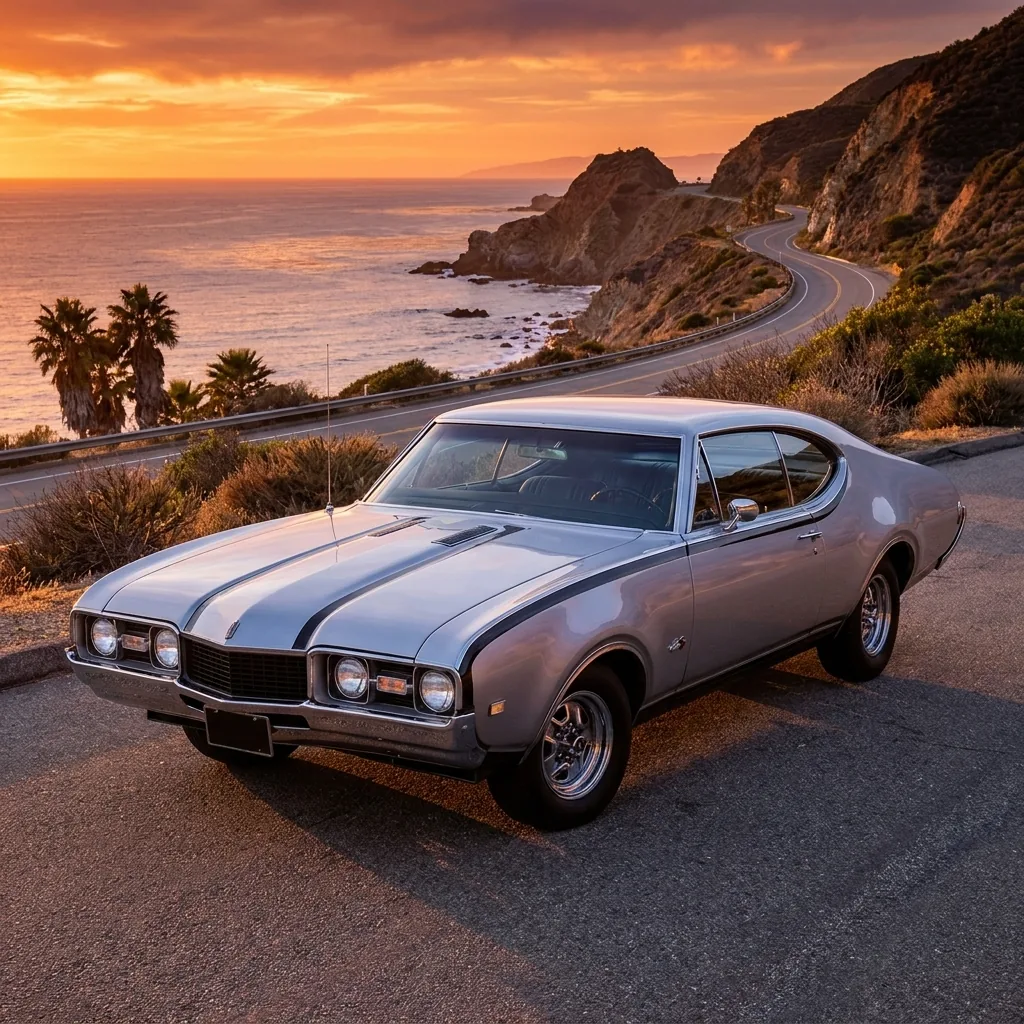
A 1969 Camaro does not need loud stripes to have an unusual history. Some of the most significant examples carried a factory-installed 427 through a special ordering process. The letters COPO have since become shorthand for extraordinary performance, but they describe an administrative route as much as a mechanical specification. That distinction is the key to understanding why these cars existed and why the exact order matters more than the nickname.
COPO stands for Central Office Production Order. Camaro Research Group documentation separates the iron-block L72 427 under COPO 9561 from the aluminum ZL1 under COPO 9560. It also describes COPO 9737 as a separate sports-car-conversion package involving items such as larger wheels, a revised front stabilizer bar, and a higher-reading speedometer. These were different instructions, not interchangeable names for one universally equipped car. [1][2]
A special order is a manufacturing instruction
A large manufacturer normally builds vehicles from defined combinations of parts. That system allows dealers to order predictable products and factories to assemble them efficiently. Special orders create a controlled way to handle requirements outside the most familiar retail combinations. The unusual outcome can be dramatic, but the underlying problem is organizational: how does the factory identify, supply, assemble, and document a nonstandard specification?
That is why COPO should not be translated simply as race car. The term itself concerns the ordering mechanism. To understand a particular performance Camaro, the reader needs to know which order number applied and what it required. This approach also prevents a common mistake: assuming that any unusual Chevrolet or any dealer-modified Camaro must have been built through the same process. Similar results can come from very different production and modification histories.
Factory installation and dealer conversion are different histories
A dealer can replace an engine after receiving a completed car. A factory can also build a car with a special engine already installed. Both routes have played roles in American performance history, but they produce different documentation and different questions. An invoice for a dealer conversion records work performed after the original assembly. A factory special order records instructions within the manufacturer’s production system.
Neither history should be disguised as the other. A documented dealer-built performance car can be highly significant on its own terms. Its importance does not require pretending that every component was installed at the assembly plant. The COPO Camaro is particularly useful for teaching this distinction because the surrounding dealer culture was so influential. Names associated with selling or promoting these cars can appear in the story without replacing the need to identify the actual origin of the mechanical configuration.
The L72 brought more than a displacement number
The iron-block 427 associated with the 1969 COPO Camaro belonged to Chevrolet’s high-performance big-block family. Its significance was the availability of that engine as part of a factory-built Camaro package. This was a different proposition from a car whose appearance merely suggested performance. Beneath familiar bodywork was hardware selected around a more demanding level of output and the systems needed to transmit it. [1]
An engine installation always affects more than the space beneath the hood. Cooling capacity, clutch or transmission requirements, axle strength, exhaust routing, and service access all become part of the job. That is why a complete factory package matters. The engine cannot be evaluated as if it were sitting on a display stand, detached from the vehicle. A strong engine in a poorly integrated installation would not reproduce the same engineering result.
Why a quiet exterior can mislead
People use visual shortcuts when identifying cars. Stripes, hood shapes, and badges are quick to recognize, so they tend to dominate memory. A special-order performance car can upset those shortcuts. The absence of a conspicuous decoration does not prove the absence of unusual equipment. Conversely, adding the right decoration does not create the manufacturing history that the badge implies.
This is the appeal of the sleeper idea, but the term needs care. A particular COPO Camaro may have gained dealer graphics, later modifications, or a restored presentation that is far from subtle. The historical lesson is not that every car looked identical and anonymous. It is that exterior drama and mechanical specification do not always track together. A careful reader learns to look beyond appearance without inventing hidden factory equipment whenever a car looks ordinary.
Double COPO does not mean twice the engine
When enthusiasts describe a double-COPO Camaro, they are referring to the combination of special-order provisions. In this context, the additional order commonly discussed is 9737 alongside one of the 427 orders. The phrase can sound mysterious, but its meaning becomes straightforward once the codes are treated as separate sets of instructions. It does not describe two engines, a secret displacement increase, or a universal extra horsepower figure. [2]
The higher-reading speedometer is a useful example of why details need interpretation. A speedometer’s maximum marking is not a measured top speed. It tells the reader about the instrument, not what the car can achieve under all conditions. The larger wheel and tire arrangement likewise needs its own description. Bundled equipment can change the package, but each component should be explained for what it actually does rather than used as a vague signal of superiority.
A paperwork trail can explain a mechanical combination
Imagine finding a car with a large engine, unusually sized wheels, and a higher-range speedometer. Those components might have been assembled at different times, or they might reflect a coordinated original order. The physical parts alone do not tell the sequence. An order record can explain why the combination existed, while dates and component identification help test whether the evidence agrees.
This is especially useful with special-production cars because the ordinary retail brochure may not tell the entire story. The absence of a familiar option box does not prove that a factory combination was impossible. Equally, an unusual combination is not automatically evidence of a secret order. The COPO system makes documentation unusually valuable: it provides a way to connect administrative instructions with a configuration that might otherwise look like an assortment of later modifications.
Reading the evidence around a surviving car
An authentic history is usually built from several pieces that agree. Factory documentation where available, engine and drivetrain identification, period dealer records, and ownership history can support one another. A single copied document or a newly installed badge cannot carry the whole argument. Restored cars may also contain replacement components, so the identity of the vehicle and the originality of every part are separate questions.
The COPO Camaro’s strongest story is therefore not a vague claim that Chevrolet secretly built an unbeatable machine. It is a specific account of how an ordering system allowed an unusual production combination to reach customers. The codes matter because they connect the paperwork to the hardware. Once that relationship is understood, the familiar Camaro shape becomes more interesting. Behind the quiet exterior was a deliberate factory instruction, and that instruction is what gives the car its place in performance history.