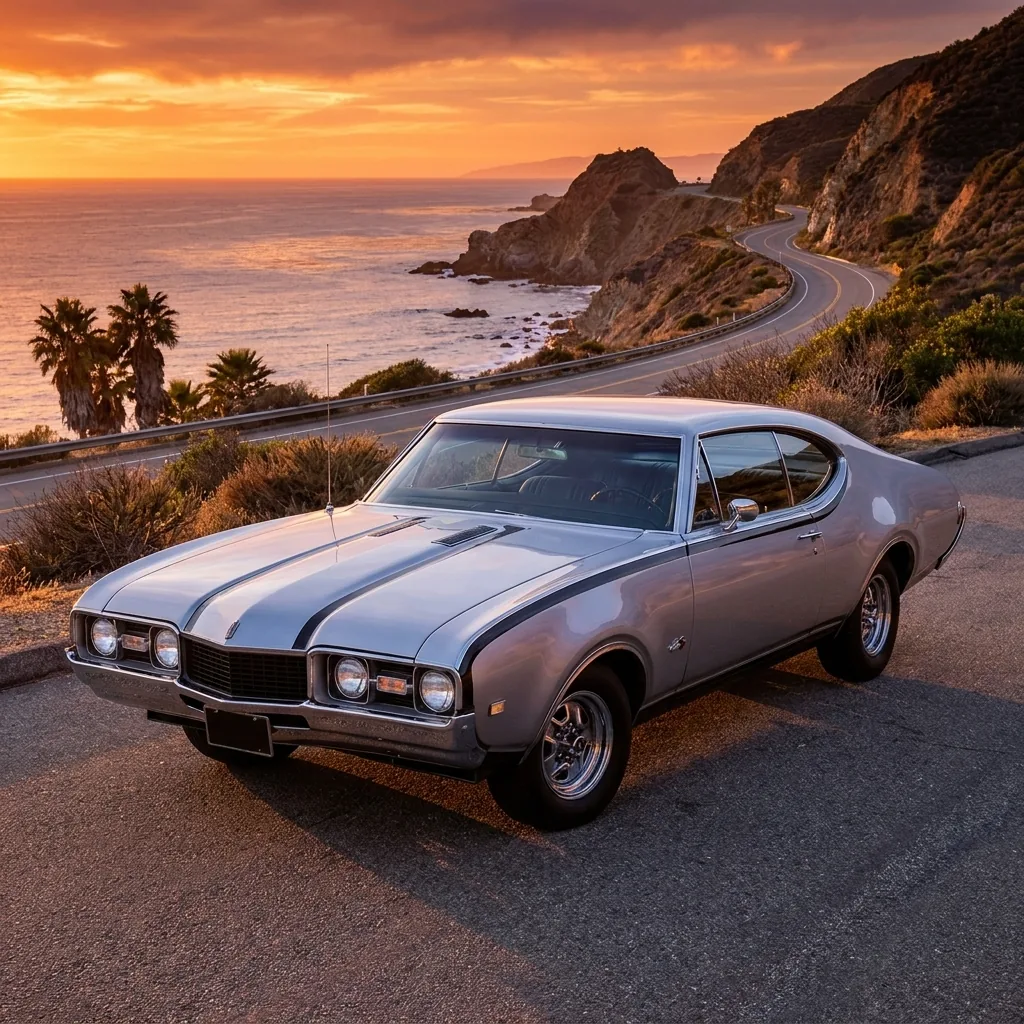
The name 442 is short enough to fit on a fender, but its meaning is not as simple as a permanent three-number formula. The model evolved, and so did the equipment behind it. By 1970, the Oldsmobile 442 occupied a serious place in the performance-car market, with the W30 option adding a more specialized specification. Understanding the car requires reading the model year and option together instead of treating the badge as a complete technical description.
General Motors’ heritage collection documents the 1970 442 and its W30 configuration. Period-style specifications associated with W30 identify a 455 cubic inch V8 advertised at 370 horsepower. The important point is not merely the number. W30 represented a coordinated approach to engine breathing and performance equipment within the 442 range. A car described only as a 442 therefore has not yet been identified as a W30. [1][2]
A performance package is an agreement among parts
An engine makes useful output when its components work toward a compatible operating range. Air enters through the induction system, passes the valves, fills the cylinders, and exits through the exhaust. Valve timing determines when those events occur. Improving one part while leaving a severe restriction elsewhere can produce less benefit than expected. A factory package is valuable because it organizes several choices around an intended result.
This is the right framework for W30. Rather than treating the designation as a mysterious source of extra power, ask how the engine and supporting equipment were selected to work together. The same principle applies to any carefully developed performance option. A list of impressive parts is not automatically a coherent package. Their dimensions, calibration, and operating assumptions must agree. That agreement is the engineering content hidden behind a short ordering code.
Air temperature and airflow are different ideas
A performance intake may be designed to reduce restriction, draw cooler air, or both. These goals are related but not identical. Cooler air can be denser under comparable conditions, while lower restriction can reduce the pressure loss through the intake path. A visible scoop does not prove either result by itself. The air must actually reach a suitably sealed and functioning induction system.
This matters when discussing classic ram-air language. A scoop does not behave like a mechanical supercharger, and its presence does not establish a universal horsepower increase at every speed. Vehicle speed, scoop location, pressure conditions, ducting, and filtration all influence the result. On a restored W30, missing seals or altered components can change how the original arrangement works. The visual feature is a useful clue, but understanding the complete path is more informative than counting openings in the hood.
Why five horsepower can hide a bigger story
Comparisons of period Oldsmobile ratings can make the W30 look like a small numerical step. A peak rating, however, gives only one point in the engine’s operating range. Two engines can have similar advertised maxima while differing in where they produce power, how they respond, or what equipment supports them. The historical rating should be reported accurately without assuming that it summarizes every practical difference.
At the same time, a modest advertised difference is not permission to invent a much larger secret output. A defensible alternative figure needs a documented test with a defined specification. The better explanation is that engine behavior is a curve, and the car is a system. Readers can understand why a package matters without being handed an unsupported number that supposedly corrects the manufacturer. Precision includes knowing when a measurement does not answer the whole question.
Transmission choice affects the interpretation
The transmission determines how the engine is connected to changing road speeds. A manual gearbox and clutch ask the driver to manage that connection directly. An automatic adds a torque converter and its own operating characteristics. Factory engine details can also vary with the transmission combination, so a statement about one W30 specification should not automatically be applied to every other example.
This is especially important when comparing surviving cars. A modern build may use a different transmission, altered shift behavior, or gearing chosen for highway comfort. Those changes can be sensible for an owner’s goals, but they create a different driving experience from the original combination. A responsible article identifies the configuration being discussed. The W30 name provides a starting point; it does not eliminate the need to describe the rest of the drivetrain.
Colorful components are clues rather than proof
Some performance cars become associated with distinctive underhood details, and the W30 is a good example of how quickly a visible feature can become an authentication shortcut. A recognizable component may support identification, but reproduction parts and later changes mean it cannot establish the car’s complete history. The same limitation applies to emblems, stripes, and a familiar air-cleaner arrangement.
For a specific vehicle, documentation should explain the original order, while inspection explains what is present now. These two forms of evidence answer different questions. A car can be genuine and contain replacement parts, or it can reproduce a specification without having been built that way initially. Clear language makes both situations understandable. Ambiguous originality claims usually create more confusion than the mechanical differences themselves.
Airflow ratings are measurements with conditions
Carburetors are often compared by cubic feet per minute, but that rating is measured at a defined pressure difference. It is not a promise that the engine continuously consumes that quantity of air. Engine speed, volumetric efficiency, throttle position, and the rest of the induction system determine actual demand. Comparing ratings without their test convention can create another misleading numerical contest.
For a W30, this makes the matching of components more important than the largest advertised carburetor number. A useful carburetor must meter fuel accurately through the operating range the engine actually uses. The manifold and heads must then distribute and accept the mixture effectively. The performance package’s value lies in coordinating those functions. Replacing one part with a larger item is not automatically an improvement if it weakens the relationships that the original combination was designed to preserve.
Why the Oldsmobile approach remains distinctive
The 442 W30 belongs to a period when different divisions could offer cars with related market ambitions but distinct engines and personalities. It should not be described as a Chevrolet wearing different trim simply because both brands sold large V8 performance cars. The engine architecture, option structure, and brand-specific development deserve their own attention. That is part of what makes the period interesting to study.
The W30’s most useful secret is therefore the value of coordination. Its significance comes from the relationship among breathing, tuning, drivetrain, and vehicle identity. A reader who sees only a short code may miss that work. A reader who understands the system can appreciate why the option remains meaningful even without a dramatic record claim. The 1970 442 W30 demonstrates that a memorable performance car can be defined as much by a carefully selected combination as by the largest number printed in an advertisement.