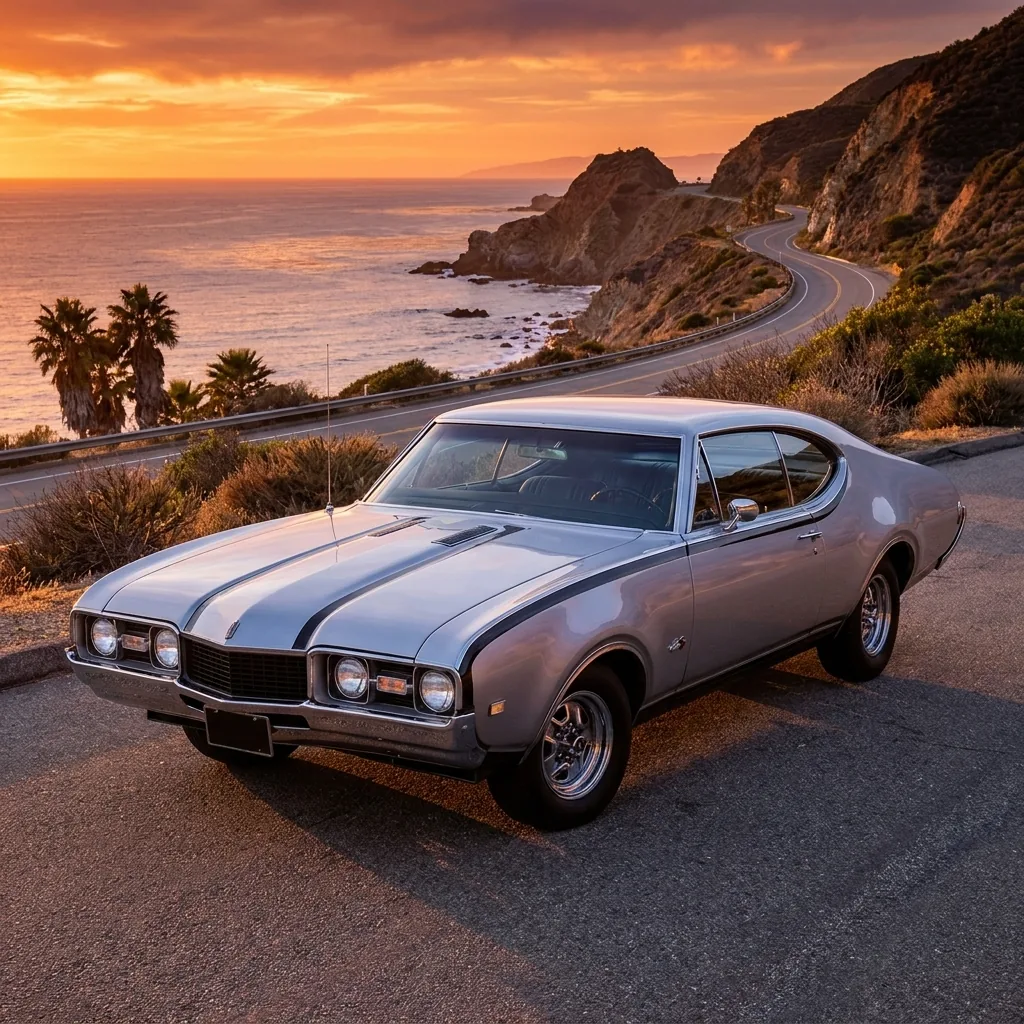
The 1970 Chevrolet Monte Carlo SS454 approached performance with a different personality from a stripped drag special. Its long-hood coupe shape and more composed presentation suggested a car that could combine strong acceleration with everyday comfort. One of its most interesting details supports that interpretation directly: the SS454 package included automatic level control at the rear. The system is less famous than the engine, but it explains a great deal about the car’s intended role.
The First Generation Monte Carlo Club documents the SS454 package for 1970 and 1971, including the LS5 454, automatic transmission, and level-control equipment. Its technical guide identifies the compressor, leveling valve, air shocks, and associated lines. The Monte Carlo Registry likewise distinguishes the package from the later Custom option. These records establish that SS454 describes a specific production combination, not simply any Monte Carlo fitted with a large Chevrolet engine. [1][2]
A loaded car changes its stance
Passengers and luggage add weight, and the suspension compresses under that load. At the rear of a car, the change can alter body attitude and available suspension travel. A vehicle that sits noticeably lower at the back may also change headlamp aim and the relationship between its front and rear geometry. Maintaining a suitable ride height is therefore a practical concern, not only a cosmetic preference.
Automatic level control addresses that concern by responding to the vehicle’s loaded position. In the Monte Carlo system, a height-related valve and air-assisted rear shocks form part of the arrangement. The goal is to help restore the intended rear stance as load changes. This should not be confused with a modern fully active suspension that continuously commands each wheel’s motion. The original system had a narrower and more specific task. [1]
Level control did not replace every suspension function
The car still needed its normal springs, dampers, control arms, bushings, and tires to support and control motion. A leveling system does not make worn suspension components healthy, and it does not erase the vehicle’s load limits. It works within the overall design. Raising the rear of an overloaded car until it looks level is not proof that the tires, axle, brakes, or structure are operating within their intended capacity.
This distinction is useful when examining a restored example. The presence of air lines and a compressor does not establish that the system operates correctly. Leaks, valve condition, shock compatibility, and linkage adjustment can affect the result. A visually complete installation and a functioning installation are different findings. The historical interest lies in how Chevrolet integrated the feature, while the condition of an individual car requires its own inspection.
The LS5 belongs in the engine description
The 1970 SS454 used the LS5 454 specification with a period advertised rating of 360 horsepower. It should not automatically be described as an LS6 because the Chevelle also offered a famous 454 engine that year. Shared displacement and a shared manufacturer are not enough to establish identical specifications. The relevant club documentation notes the absence of substantiated factory LS6 Monte Carlo evidence. [1]
That distinction matters because a later engine swap can be entirely plausible. A Monte Carlo may now contain a more powerful big-block, and it may be an excellent car. Its current engine does not rewrite its factory build history. Describing the original package separately from the present installation gives the reader both useful facts. It also avoids turning an attractive mechanical possibility into an unsupported claim about production.
An automatic fit the broader purpose
The SS454 package’s automatic transmission supported a road-car identity that did not require the driver to manage a clutch. This was compatible with serious engine capability. The transmission type alone does not determine whether a car belongs in a performance discussion. Torque converter behavior, gear ratios, calibration, vehicle mass, and traction all influence how the available power is used.
The Monte Carlo illustrates why performance and convenience need not be opposites. A buyer could want substantial engine response and still prefer an automatic, a comfortable cabin, and equipment that helped preserve ride height with luggage aboard. Those preferences define a different package from a competition-focused special, not an inherently less legitimate one. The engineering should be judged against the intended use rather than a single cultural image of what a muscle car ought to be.
Discreet identification suited the shape
The first SS454 Monte Carlo did not rely on the same visual language as every contemporary performance coupe. Its identification was relatively restrained, and the basic body emphasized proportion more than exposed competition cues. This makes it a useful example of how a powerful engine could be presented within a personal-luxury format. The car did not need a removable hood to communicate its role to the buyer who wanted it.
That restraint also means identification should not rely on a quick exterior glance. The club’s research points toward documentation and the package’s mechanical details. Some equipment can be added later, while original equipment can be removed during repairs. The question is therefore not whether one recognizable component exists, but whether the car’s records and present configuration form a coherent account. This is particularly important for a model whose performance identity is easy to reproduce with badges.
A level body does not prove equal axle loads
Ride height and axle load are related, but they are not the same measurement. A suspension-assist system can raise the rear body while the added passenger or luggage mass remains on the vehicle. The tires and structure still carry that weight. This is why appearance alone cannot establish whether a car is within its loading limits.
The Monte Carlo’s level-control system addressed stance as the load changed. Its job was narrower than making the additional weight disappear or preserving identical handling under every condition. A fuller car still has more mass to accelerate and stop. The feature belongs to a thoughtful road-car package precisely because it addressed a practical effect of real use. Understanding its limits helps explain its usefulness without assigning it capabilities that no ride-height system could provide.
The useful comparison with a Chevelle
The Monte Carlo and Chevelle occupied related territory in Chevrolet’s range, but they pursued different presentations and could carry different engine specifications. Comparing them only by a 454 emblem hides that distinction. The better comparison includes the body, intended experience, equipment, and actual engine code. Those details explain why two cars with similar displacement can appeal to different drivers.
The Monte Carlo SS454’s less obvious secret is its concern for how the complete car behaved when used as a road coupe. Automatic level control belongs in the same story as the big engine because both helped define the package. One provided substantial performance potential; the other addressed changing passenger and luggage loads. Together they show a version of American performance that was willing to combine power with practical accommodation, rather than treating comfort as something that had to be removed.