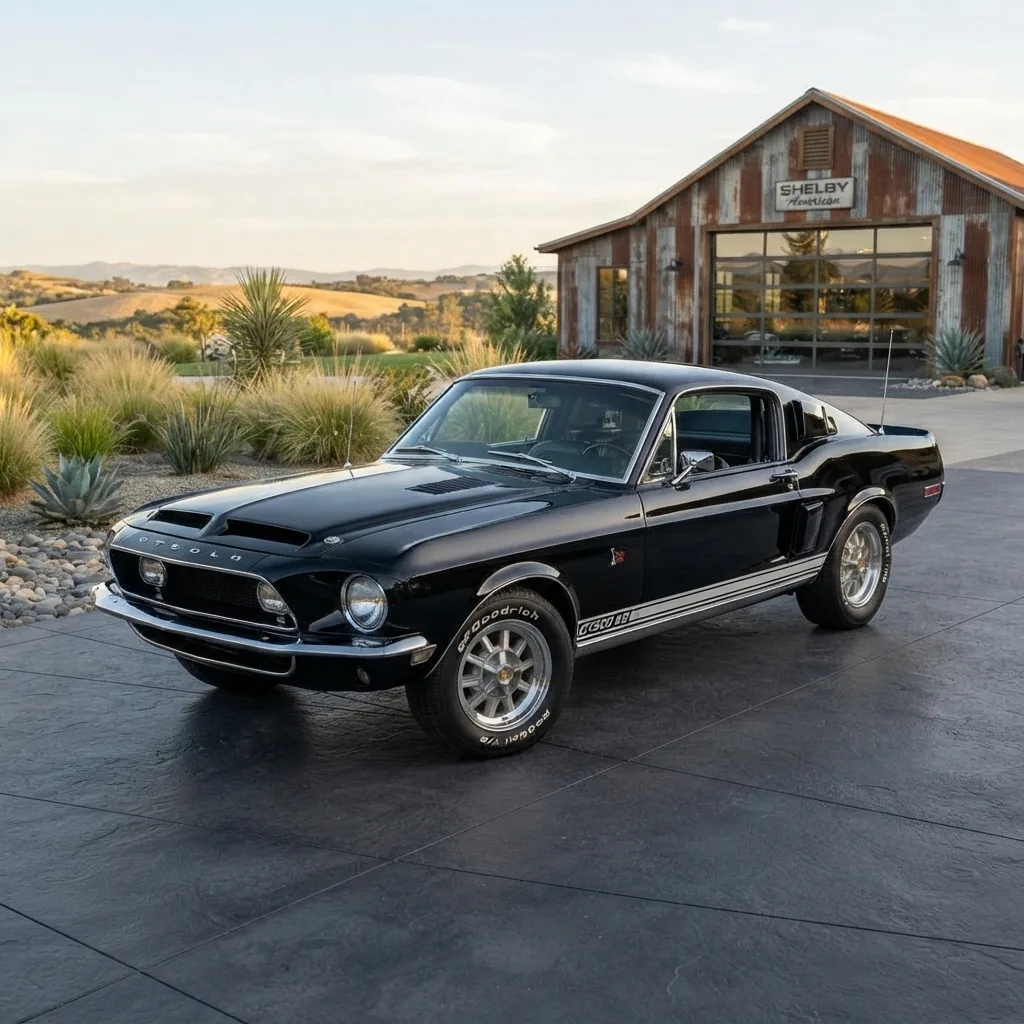
The Boss 429 Mustang is a car whose engine size tells only part of the difficulty. The important problem was also physical width. A powerful engine can fit on a specification sheet long before it fits between a car’s suspension structures and surrounding equipment. Installing the Boss engine in a Mustang required special work, and that packaging effort is central to understanding why the model is more than another big-block option.
The Boss 429 was produced for the 1969 and 1970 model years in connection with Ford’s effort to establish its new engine for NASCAR use. Kar Kraft carried out the specialized Mustang conversion work. Documented descriptions identify modified shock-tower areas as part of making room for the broad engine. The Mustang served the engine’s production-homologation story even though that does not mean NASCAR teams were racing ordinary Boss 429 Mustangs on the superspeedways. [1][2]
Displacement and physical size are different measurements
Displacement measures the volume swept by the pistons. It does not directly specify the engine’s external width, height, or length. Cylinder-head design, valve arrangement, intake, exhaust, and accessories can make two engines of similar displacement occupy very different spaces. The Boss 429’s heads and associated architecture created an installation problem that a cubic-inch number alone cannot communicate.
This is a common issue in engine swaps and production development. The block may appear to fit while the exhaust manifolds collide with structure, the steering gear lacks clearance, or essential service points become inaccessible. The engine also moves on its mounts under load, so static clearance is not the whole requirement. A successful installation has to work as a moving, heating, vibrating system inside a vehicle whose other functions remain necessary.
Shock towers are part of the structure
The areas around the front suspension are not empty sheet metal waiting to be trimmed away. They locate and support components that carry substantial loads. Altering them to clear an engine requires consideration of strength, geometry, and manufacturing consistency. The need for specialized conversion work reflects the seriousness of that integration problem. Making space is only acceptable if the car can still support its intended loads correctly.
That is why the Boss 429 should not be reduced to the instruction to fit a larger engine and hammer the surrounding panels until it clears. The historical program involved a controlled solution for a specific vehicle and powerplant. Modern reproductions or modified cars need their own engineering assessment. The existence of a famous factory-associated conversion does not make arbitrary structural changes equivalent to the documented original work.
Homologating an engine is different from racing the street car
In production-based competition, eligibility rules can require evidence that an engine or design exists in an approved production context. The roadgoing car used for that purpose and the actual competition car need not be the same model in every respect. This is the distinction at the center of the Boss 429 story. The Mustang helped support the engine program, while NASCAR competition involved separately prepared vehicles.
Keeping the two roles separate avoids an easy but misleading headline. A Boss 429 Mustang can have a strong NASCAR connection without being a showroom version of a Mustang that raced in that period’s premier stock-car series. The connection is through the engine and eligibility strategy. That is already unusual and interesting. It does not need to be simplified into an inaccurate claim about which body appeared on the track.
The hood scoop was only the visible clue
The prominent scoop signals the unusual engine beneath it, but the less visible changes are equally revealing. Engine-bay clearance, component placement, and supporting systems determine whether the installation is viable. Cooling, fuel delivery, exhaust routing, and service access all have to coexist. The exterior feature is the part spectators notice, while the surrounding integration is what allows the car to operate.
This contrast makes the Boss 429 especially rewarding to examine carefully. A photograph of the open engine compartment can show how completely the engine occupies the available space. It also raises useful questions about how individual components were positioned. The answer should come from the documented factory-associated configuration, because many surviving cars have been modified. An impressive engine bay is evidence of what is installed now, not automatically of every detail present when the car was built.
The road engine had its own operating conditions
A racing engine’s architecture does not guarantee that a street version will behave exactly like a prepared competition engine. Induction, camshaft, exhaust, compression, and calibration can differ. The road car must also work with its own gearing, mass, and tires. These factors explain why the engine’s reputation cannot be translated directly into a universal road-car acceleration figure.
Factory horsepower ratings and later dynamometer results likewise need their original context. A rebuilt engine with altered parts is a different test subject from an untouched period specification. The most useful explanation identifies the measurement method and configuration. The Boss 429’s engineering importance survives that precision easily. Its broad engine and difficult installation are concrete facts, independent of whichever unverified power number happens to be circulating in an enthusiast discussion.
Service access is a design constraint
An engine installation needs room for hands and tools as well as for components. Spark plugs, belts, hoses, and fasteners eventually need attention. If a part fits only when several unrelated systems are removed, the installation may be workable but more expensive and time-consuming to maintain. Production engineers have to consider that practical cost alongside the immediate goal of fitting the engine.
The Boss 429’s crowded compartment makes this concern tangible. The broad engine changed the space available around the heads and accessories, while the Mustang still needed steering, brakes, and cooling. The special conversion is therefore interesting even before discussing horsepower. It shows how a performance project can turn routine service requirements into packaging problems that must be solved within an existing body. Making a car operate is one task; making its components accessible enough to support is another.
What makes a documented example informative
A surviving Boss 429 can reveal both the engine program and the specialized conversion process. Identification records, conversion details, and physical inspection help connect the car to that history. A replica can reproduce the appearance and even the engine architecture, but it does not acquire the same production record by doing so. Both deserve clear descriptions rather than an ambiguous use of the badge.
The car’s most revealing secret is the amount of work hidden around the engine. Ford’s performance objective created a production requirement, and that requirement placed an unusually wide V8 inside a body that needed special adaptation. The result demonstrates that automotive engineering is often a packaging discipline as much as a power contest. The engine attracted the attention, but making the rest of the Mustang accommodate it is what turned the idea into an actual vehicle.