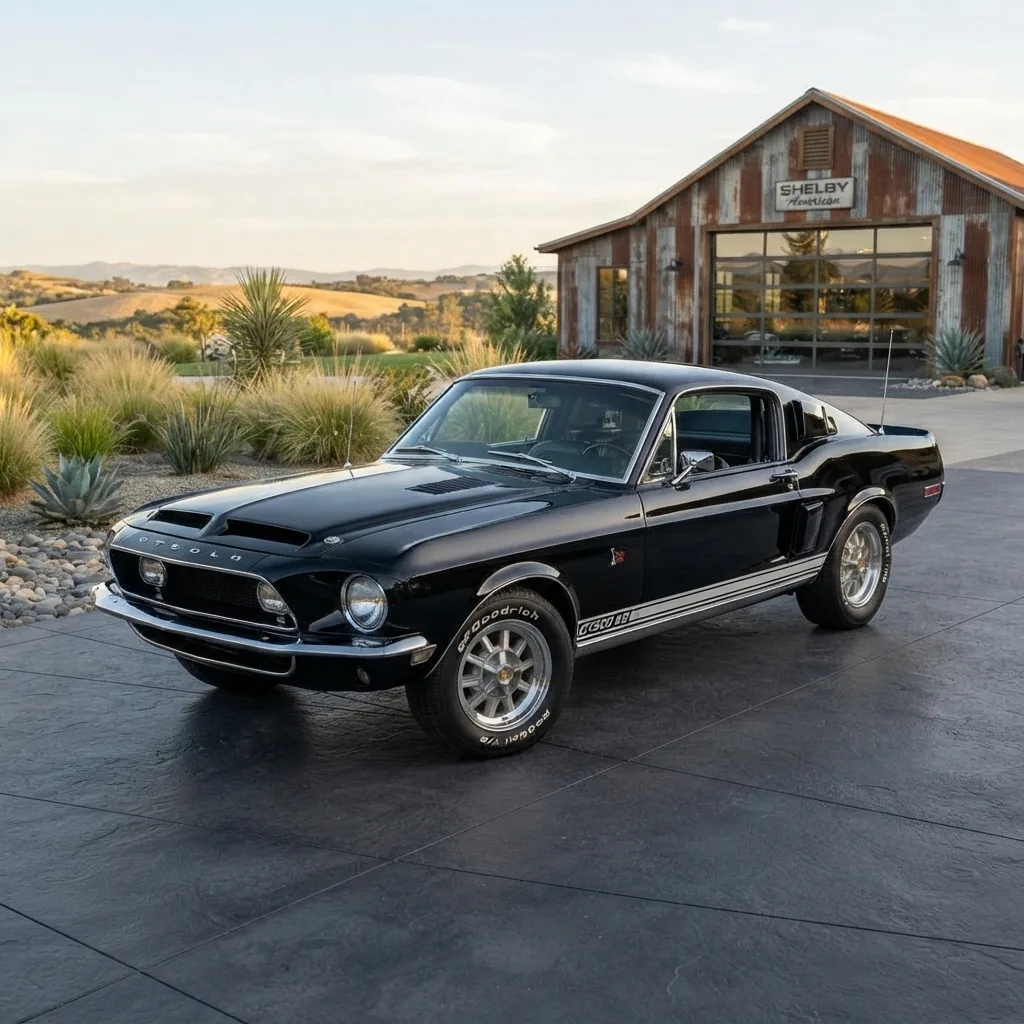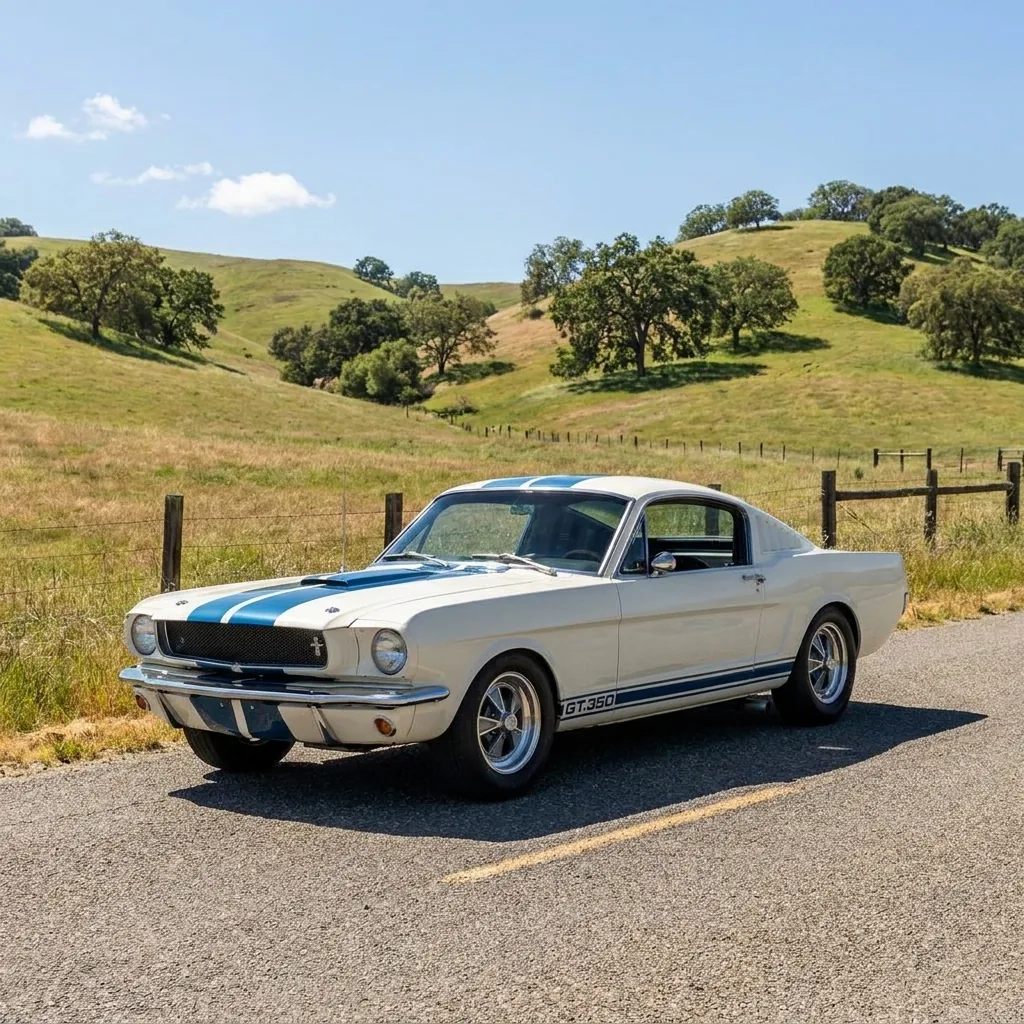
The first Mustang was a commercial success before the Shelby GT350 appeared. What it needed was a more focused competition identity. A popular sporty car and a credible road-racing car are not automatically the same thing. Shelby’s assignment was to close that gap by changing how the Mustang worked, not merely how it looked. The resulting 1965 GT350 made the relationship between street presentation and competition preparation central to its identity.
Shelby American’s history describes Lee Iacocca asking Carroll Shelby to establish a stronger performance image for the Mustang. It identifies the GT350 with success in the SCCA B Production category. The original car used Ford’s high-performance 289 cubic inch V8 as its foundation, while the broader package addressed the demands of road-course use. These facts explain why the GT350 story should begin with the assignment rather than with a stripe pattern. [1][2]
A lap asks more than a launch
Drag racing concentrates on acceleration over a defined distance. A road course repeatedly asks a car to accelerate, brake, turn, and do the sequence again. The engine’s output matters, but so do brake consistency, tire loading, cooling, and the driver’s ability to place the car accurately. A vehicle can feel powerful in a straight line while becoming difficult to manage over several demanding laps.
This changes the development priorities. The builder needs a balanced combination rather than a single spectacular specification. More power can even expose shortcomings in braking or traction by increasing the speed reached before the next corner. Shelby’s work is best understood within that complete cycle. The GT350’s significance was that it connected a popular production body with a more concentrated approach to repeated performance, where the supporting systems mattered every time the road changed direction.
The small block suited the assignment
The 289 belonged to Ford’s small-block V8 family. Its presence reminds us that a serious performance car did not have to begin with the largest available engine. Physical size and mass influence the vehicle around the powerplant, while breathing and operating speed influence the output the engine can deliver. A suitable smaller engine can support a balanced package when the intended use rewards more than straight-line force.
The GT350’s engine should nevertheless be identified by its actual year and specification. Later Shelby models and modern continuation cars may use different displacements, materials, and components. A current manufacturer page describing a newly built interpretation is not proof of the parts installed in 1965. The historical car and the later recreation can share an idea while differing mechanically. Keeping them separate preserves the engineering story instead of flattening several generations into one imagined specification.
Suspension geometry changes what the tires do
A tire’s contact with the road changes as the suspension moves and the body rolls. Geometry determines how the wheel’s orientation changes through that motion. Springs and dampers influence the movement, but they do not replace geometry. This is why suspension development can involve relocating attachment points or altering relationships among components, rather than simply fitting stiffer springs and declaring the car ready to race.
The useful principle is that the tire must remain effective while the vehicle is turning and braking. Too much stiffness in the wrong place can reduce compliance on an uneven surface, while inadequate control can make the car slow to settle. The best combination depends on the tires, surface, and intended use. The GT350’s chassis emphasis belongs in this broader context: a road-racing identity required control of the wheel and body relationship, not only an engine capable of producing more output.
Brakes must repeat their work
Every braking event converts vehicle motion into heat. A system that stops the car once may behave differently after repeated hard use if it cannot manage temperature. Friction material, rotor or drum design, airflow, fluid condition, and the overall setup influence consistency. A road-course package therefore needs to consider what happens after the first impressive stop.
The driver also needs predictable response. A changing pedal or inconsistent balance can force earlier braking and reduce confidence even when the engine remains strong. That is why braking equipment is part of the performance story rather than a separate safety appendix. On a historic car today, age and maintenance are additional variables. A restored appearance cannot establish the condition of hoses, seals, friction surfaces, or fluid. The actual system must be evaluated as a functioning assembly.
Street and competition versions need separate descriptions
The GT350’s racing success makes it tempting to assign competition specifications to every street car. That shortcut loses important distinctions. A racing version can have different body details, equipment, weight, and preparation. A roadgoing example must satisfy another set of practical requirements. Shared identity does not mean that every component and performance result transfers unchanged between the two.
Modern continuation and replica programs add a third category. They may reproduce selected historical features while offering contemporary changes. Such cars can demonstrate the original concept effectively, but their specifications must be labeled as their own. A modern engine option, independent rear suspension, or updated transmission should not be projected backward onto an original 1965 GT350 simply because an official Shelby-branded product offers it today. The date and build context remain essential.
Repeated braking makes energy management visible
For the same vehicle mass, doubling speed means approximately four times as much kinetic energy must be removed to bring the car to rest. A road course repeatedly creates that heat load, often with limited time for the brakes to cool. The calculation is general, but it explains why a successful engine upgrade can immediately create a larger braking problem.
The GT350’s road-racing purpose makes that relationship central. Stronger acceleration may raise the speed reached before the next corner, and the brakes then have more work to do. Improving one part of a lap can therefore increase demands elsewhere. This is why the package deserves to be understood as a whole. Engine performance, brake capacity, airflow, tires, and the driver’s rhythm become connected through the energy the car gains and loses on every circuit.
The stripes were the visible end of the process
The GT350’s presentation helped viewers recognize it, but the image worked because there was a focused mechanical story behind it. This relationship is easy to reverse in memory. Once a paint scheme becomes iconic, it can seem as though the performance identity came from the graphics. In reality, the lasting appeal depends on the connection between the recognizable appearance and the car’s developed purpose.
The first GT350 therefore offers a useful way to judge any performance package. Ask what job the builder intended, what systems were changed to support it, and how the resulting vehicle demonstrated that capability. Shelby’s Mustang made those questions unusually clear. Its secret was not one hidden part. It was the discipline of treating the engine, chassis, brakes, and competition role as one assignment, giving a successful sporty car a much more specific reason to be taken seriously.